
You might be wondering about who really owns HR data quality in your organization. Companies of all sizes face this challenge, HR data governance responsibility gets split between departments and creates confusion and ends up causing poor data quality.
Our experience shows that HR data governance frameworks need clear ownership and accountability to work. Treating HR data quality as a product instead of just an asset makes it a strategic priority. This affects everything from compliance to analytics. Modern HR data governance practices focus on building a single source of truth through shared responsibility. The approach becomes vital as more organizations use AI in HR functions. Data quality directly shapes how well algorithms perform and what they produce.
This piece dives into the people who should own different parts of HR data quality. You’ll learn how to create an effective HR data governance model and practical ways to boost data integrity. It also shows how distributed ownership can reshape your HR Data Lifecycle management. This ensures you stay ready for audits while maintaining compliance.
Table of Contents
-
- Why HR Data Quality Is Everyone’s Job?
- How Bad Data Affects Decision-Making?
- HR Data’s Role in Compliance and Trust
- The Need for Distributed but Clear Ownership
- Breaking Down the HR Data Governance Model
- Who Owns What: Role-Based Responsibilities
- Tools and Tactics to Improve Data Quality
- Building a Culture of Data Responsibility
- Key Takeaways
- FAQs
Why HR Data Quality Is Everyone’s Job?
Organizations pay a heavy price for poor HR data quality, yet they don’t deal very well with pinpointing who should maintain it. The reality? Everyone shares the responsibility for HR data quality and not just HR or IT teams.
How Bad Data Affects Decision-Making?
Bad HR data weakens your ability to make sound business decisions. Strategic planning takes a hit when executives receive reports with wrong employee information, compensation data, or productivity metrics.
Let’s look at a workforce planning scenario where headcount numbers are off by just 5%. This small error can result in:
- Departments hiring too many people at high costs
- Critical functions becoming dangerously understaffed
- Budget waste on non-existent positions
HR analytics has become more sophisticated, and the quality of underlying data matters more than ever. Predictive models for turnover, involvement, or performance only work as well as their input data. Research shows HR leaders waste up to 50% of their analytics time cleaning data instead of learning from it.
HR Data’s Role in Compliance and Trust
Poor HR data quality creates problems with regulatory compliance and organizational trust. Wrong compensation data can trigger audits or legal action when it shows pay gaps that break equal employment laws.
Workers lose faith quickly when they see mistakes in their personal information, benefits enrollment, or payroll. Each error damages their confidence in HR processes. Constant data errors tell employees that accuracy and attention to detail don’t matter to the organization.
HR data plays a vital role in financial reporting for public companies. Data errors can create material misstatements that reach way beyond the reach and influence of HR’s traditional role. These mistakes ripple through to investors, regulators, and other stakeholders across the ecosystem.
The Need for Distributed but Clear Ownership
Modern HR data environments are too complex for centralized ownership. No single person or department can handle the entire HR data lifecycle alone. Successful organizations use a distributed ownership model with clear accountability.
Organizations that treat HR data as a product rather than just an asset change their approach to quality. This transformation makes everyone responsible for maintaining data integrity, from employees updating their address to the HRIS administrator setting up system rules.
All the same, distributed ownership needs clear documentation of responsibilities for data quality. Accountability gaps let errors multiply without this clarity. The best HR data governance frameworks include:
- Primary data owners for specific domains (compensation, talent, etc.)
- Clear quality standards for each data element
- Regular audit processes with accountable parties
HR data quality needs a careful balance—shared responsibility with clear accountability. Organizations that get this right build strong foundations for trusted analytics, compliant operations, and smart strategic decisions.
Breaking Down the HR Data Governance Model
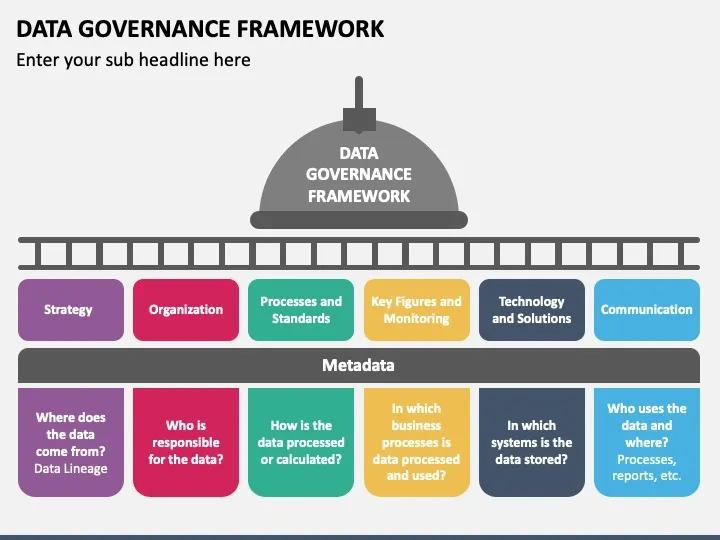
Image Source: SketchBubble
Building a successful HR data governance model takes time and dedication. You need careful planning, open communication, and support from your organization to create a framework that works. Let’s get into the key elements that make HR data governance successful in real-world situations.
Core Components of a Governance Model
A strong HR data governance framework needs several connected elements that work together to keep data accurate. These components include:
- Defined Data Ownership – Clearly outlining who owns and manages specific HR data elements
- Quality Standards – Establishing measurable criteria for data accuracy, completeness, and timeliness
- Access Protocols – Developing rules for how HR data is accessed, used, and protected
- Governance Documentation – Creating detailed guidelines that outline goals, metrics, and responsibilities
- Formal Oversight – Setting up governance councils with cross-functional representation
Your data governance tools must merge with your HRIS, payroll, and other HR-related systems to maintain consistency across all data sources.
Arranging Roles with Responsibilities
A good governance model treats HR data as a product rather than just an asset. Each stakeholder needs specific responsibilities:
Employees own their personal data accuracy and serve as the first line of defense against errors. They need to understand why data quality matters to them personally.
Managers and HR BPs handle their organizational data, which affects their ability to run people-related programs successfully. They feel the impact first when reporting relationships are wrong or team data is inaccurate.
HR Operations runs targeted audits and uses reports to find data anomalies, often working with HRIS teams. They act as quality controllers who can spot patterns that need system changes.
Other stakeholders have supporting roles: HR Reporting spots anomalies during analysis, HRBPs might notice issues during client consultations, and teams like IT, Payroll, and Finance must verify mass updates to avoid errors. How to Document and Communicate Ownership?
Clear documentation turns unclear responsibilities into real accountability. This process involves creating:
Data Dictionaries that define each data element, its owner, quality standards, and acceptable values. These become your single source of truth for HR data definitions.
Role-Based Responsibility matrices showing which stakeholders are Responsible, Accountable, Consulted, or Informed (RACI) for different data types. This shows who makes decisions versus who carries out tasks.
Governance Charters outlining the mission, membership, and meeting schedule of your data governance council.
Documentation alone won’t cut it and responsibilities must be actively shared. Include data ownership concepts in new hire and manager training, put responsibilities on your company intranet, or send regular reminders to review data.
Clear communication channels help identify and route data issues to the right owners quickly. Everyone knowing who owns what leads to faster solutions and prevents small issues from becoming big problems.
Who Owns What: Role-Based Responsibilities
Quality HR data governance lives and dies by clear role-based responsibility. The HR data ecosystem needs clear ownership to create accountability and improve quality throughout its lifecycle. Let’s get into how different stakeholders help build a reliable HR data product.
Employees: Personal Data Accuracy
Employees lead the charge for data quality since they own their personal information. They need to keep their contact details, certifications, and dependent information up to date.
This goes beyond random updates. Companies with strong data cultures send quarterly reminders to review data. To name just one example, many companies time their seasonal reminders with business needs—asking for address checks before W-2 mailings or emergency contact updates before benefit enrollments.
Smart organizations make this fun by giving random rewards to employees who quickly review their data after prompts. This makes employees active players in the data quality ecosystem rather than just data subjects.
HR Business Partner: Org Structure and Team Data
HR Business Partners (HRBPs) handle vital organizational data elements that shape people programs. They look after:
- Team structures and reporting relationships
- Position management and arrangement
- Department hierarchies and matrix relationships
HRBPs act as quality controllers who spot anomalies during client meetings. Their close work with business leaders helps them catch organizational data issues before they cause bigger problems downstream.
This becomes especially important before major HR initiatives like performance reviews or compensation planning. Wrong reporting relationships found mid-process can throw these programs off track, which is why HRBPs must check team data integrity ahead of time.
HRIS And Ops: System Integrity and Audits
HRIS teams and HR Operations serve as technical guardians of data quality. They need to ensure system integrity by:
Setting up validation rules that keep bad data out of the system. Running targeted audits with data stewards to find quality issues. Managing the technical infrastructure that enables smooth data flows between HR systems.
HR Operations runs audits that help improve processes continuously. When they find data anomalies, they team up with HRIS to see if they need more validation logic or process changes.
Technical teams must check mass updates (like those in Workday) through test loads and follow-up audits. This stops systemic errors from corrupting the entire data ecosystem.
Legal And Compliance: Risk and Access Control
Legal and compliance teams shield the organization by setting up risk-appropriate governance for HR data. They focus on:
We set up tiered, role-based access controls that restrict data exposure based on actual need. A compliance officer might get read-only access to compensation records while an HR director needs edit rights.
It also creates legally sound data retention schedules that spell out how long to keep different types of HR data based on regulations.
The team leads breach response planning through simulated HR data incidents. These practice runs ensure everyone knows how to protect employee privacy and company interests if something goes wrong.
HR data governance works best with this well-laid-out, role-based approach to keep both quality and compliance strong throughout the data lifecycle. Organizations that treat HR data as a product with clear ownership build a foundation for trusted analytics and better decisions.
Tools and Tactics to Improve Data Quality
You need vital tools and tactics after establishing clear ownership in your HR data governance framework. Effective data quality management transforms governance theory into measurable improvements once you build on defined roles and responsibilities. Your practical approaches will turn governance theory into measurable data quality improvements once you build on defined roles and responsibilities.
Data Quality Dashboards And KPIs
Data quality metrics become useful insights when tracked and visualized properly. A good data quality dashboard monitors:
- Completeness (percentage of required fields populated)
- Accuracy (error rates in critical fields)
- Timeliness (how quickly changes are reflected)
- Consistency (variations across systems)
Data stewards and quality managers should have these dashboards available to spot problem areas quickly. Intuitive visualizations of these technical metrics help gain stakeholder support by showing progress over time.
Metadata Management and Data Dictionaries
Detailed data dictionaries form the foundation of effective data quality management and HR data governance. These documents define each data element’s semantic meaning, acceptable values, and designated owners. They help bridge the gap between IT and HR stakeholders by translating technical data structures into business-friendly language.
Good metadata management helps everyone understand what each field means. This includes documenting data lineage, tracking information flow between systems and its transformations. Regular metadata reviews, especially after system changes, prevent misinterpretation of critical HR information.
Incident Response and Breach Planning
Data incidents will happen despite preventive measures. A clear response protocol minimizes risks significantly. HR data breach planning should include:
Testing response scenarios through tabletop exercises that simulate data incidents Creating communication templates that meet regulatory requirements and ethical standards Defining notification procedures—who gets alerted, when, and through which channels
This preparation stops panic during actual incidents and ensures responses meet professional conduct requirements. HR data’s sensitive nature makes incident response planning a compliance program component rather than just an IT function.
Building a Culture of Data Responsibility
Building a strong HR data quality culture requires more than tools and policies—it demands systematic cultural change and commitment. Organizations with excellent data quality build responsibility into their daily operations through systematic approaches and cultural reinforcement.
Onboarding and Training for New Hires
New employees should learn their data responsibilities from day one through comprehensive training programs. These programs should cover:
- Data privacy fundamentals and security best practices
- Data quality’s direct effect on business outcomes
- Each employee’s specific role in maintaining the HR Data Lifecycle
Personal data ownership starts with each individual. Employees become active participants in the Data Governance Framework once they understand how their data affects downstream analytics and decision-making.
Quarterly Nudges and Gamification
Communication beyond original training reinforces data responsibility. The company sends periodic reminders based on business needs:
Employees receive quarterly messages to review their personal information with context – checking home addresses before W-2 mailings or updating emergency contacts before benefit enrollment periods.
Many companies now run “HR Data Days” similar to volunteerism events, where data review becomes part of the company’s operating rhythm. Progressive companies add gamification elements like random swag giveaways to boost participation when employees promptly review their data.
Managers can access on-demand reports that show team data issues before critical HR programs like performance reviews or compensation planning. This timing helps them understand the risks of incorrect reporting relationships or team structures.
Creating Data Stewards
Organizations with strong HR data quality culture recognize that data stewardship is a shared responsibility. They invest in recognition programs, integrate data responsibilities into performance reviews, and celebrate employees who maintain high standards consistently.
Data stewards act as champions who spread best practices throughout the organization. These individuals:
- Enforce quality standards across departments
- Monitor data health and resolve issues
- Lead training and awareness initiatives
Recognition programs that reward excellent data governance practices strengthen the culture further. The organization shows that it values data responsibility by acknowledging employees who maintain high standards consistently.
Human touchpoints become more significant to maintain trust and quality in your HR data ecosystem as automation in HR processes increases.
Key Takeaways
Implementing effective data quality in HR requires distributed ownership with clear accountability across all organizational levels.
HR data quality isn’t just an IT or HR problem—it requires distributed ownership with clear accountability across all organizational levels to prevent costly decision-making errors and compliance issues.
- Establish Role-Based Ownership: Employees own personal data accuracy, HRBPs manage org structure, HRIS handles system integrity, and Legal controls access and compliance
- Implement Automated Validation Rules: Build quality checks directly into HR systems to prevent bad data entry and conduct regular audits to catch anomalies early
- Create Comprehensive Data Dictionaries: Document who owns what data elements, quality standards, and responsibilities using RACI matrices for crystal-clear accountability
- Build a Data Responsibility Culture: Integrate data governance into onboarding, use quarterly nudges for data reviews, and gamify the process to encourage employee participation
- Treat HR Data as a Product: This mindset shift makes everyone a stakeholder in maintaining data integrity, from individual employees to executive leadership
When organizations master distributed responsibility with unmistakable accountability, they create the foundation for trusted analytics, compliant operations, and sound strategic decisions that directly impact business outcomes.
FAQs
Q1. Who Is Responsible for HR Data Quality in an Organization?
HR data quality is a shared responsibility across the organization. While HR and IT teams play crucial roles, employees, managers, HR business partners, and legal/compliance teams all have specific responsibilities in maintaining data integrity.
Q2. How Does Poor HR Data Quality Impact an Organization?
Poor HR data quality can lead to flawed decision-making, compliance issues, and erosion of employee trust. It can result in costly errors in workforce planning, inaccurate financial reporting, and compromised strategic initiatives based on unreliable analytics.
Q3. What Are Some Effective Tools for Improving HR Data Quality?
Key tools for improving HR data quality include validation rules and automated checks, data quality dashboards with KPIs, comprehensive data dictionaries, and metadata management systems. These tools help prevent errors, monitor quality, and ensure consistent understanding of data across the organization.
Q4. How Can Organizations Build a Culture of Data Responsibility?
Organizations can build a culture of data responsibility by incorporating data governance into onboarding and training programs, implementing regular “nudges” for data review, gamifying data quality initiatives, and creating data steward roles to champion best practices throughout the company.
Q5. What Role Do Employees Play in Maintaining HR Data Quality?
Employees are the primary owners of their personal information and play a crucial role in maintaining HR data quality. They are responsible for keeping their contact details, certifications, and dependent information up-to-date, and should be encouraged to regularly review and verify their data.