

HR departments everywhere talk about workflow automation and data workflow automation these days, yet many organizations still rely on a Manual HR Data Workflow that puts employee data at risk. The story repeats itself time and again as HR teams bring in new HR data software to streamline operations. They add a recruiting platform, then a performance management tool, while keeping spreadsheets to track everything else in their HR data management. This fragmented setup and HR data fragmentation, despite best intentions, creates the perfect environment for data workflow errors, duplications, and HR data security risks that quietly drain resources and derail strategic plans.
Bad HR data quality costs more than just inefficiency. Companies waste 10-30% of revenue because of poor data quality practices. HR departments face even bigger risks since they handle the company’s most sensitive information and must maintain strict HR data compliance. Companies that lack a Master Data Management strategy and a Single Source of Truth (SSOT) for HR data, whether in an HR Data Warehouse or core HRIS, face growing problems. These issues affect everything from compliance to employee experience and undermine effective HR data management. Our work with HR leaders in a variety of industries reveals a common frustration as current solutions don’t deal very well with the root cause of data quality issues. This piece explains why traditional approaches miss the mark and shows how the right HR workflow automation platform can change your HR operations. The focus on Master Data Management helps protect your people data.
Table of Contents
The Real Cost of Manual HR Data Workflows
Manual HR data workflows create a harsh financial reality for organizations of every size. Companies face massive costs that add up quietly in HR functions of all types. Each payroll error costs an average of $291 dollars to correct, and 20% of payrolls contain errors. A company with 1,000 employees could face 2,640 potential errors annually, costing $768,240 dollars just to fix payroll mistakes.
Form I-9 errors show up in 12% of cases, and federal penalties range from $220 to $2,191 dollars per incorrect form. Mid-sized companies with just 60 incorrect I-9 forms could face fines up to $131,460 dollars.
Multiple HR systems and disconnected HRIS Data Management make these problems worse. Companies typically use an average of 6 different HCM providers to manage their employee lifecycle and HR data workflows, which leads to:
- Data silos that hurt reporting accuracy (80% report problems with workforce data and HR Data Warehouse reporting)
- Security risks with each extra system
- Lost productivity when switching between applications (47% of HR employees face this challenge)
Staff well-being raises equal concerns. Almost all HR professionals (98%) experience burnout, and 42% report emotional exhaustion. HR teams dedicate 57% of their time to administrative tasks instead of strategic work.
Small business owners feel the burden even more, as 45% spend about one day each week handling HR administrative tasks rather than building their business. Companies need HR workflow automation, data workflow automation, and proper Master Data Management now more than ever.
Why Traditional Fixes Don’t Work
HR teams try to solve their data quality problems with traditional approaches to data workflow that end up falling short. Many organizations add new recruiting platforms, buy standalone payroll software, or set up isolated performance management tools. These changes only leave them with more complexity than before in their HR data integration automation efforts. Let’s look at the 3 most common solutions and their challenges:
The Excel “Quick Fix” (Manual Cleaning) – The Illusion of Control
When an HR analyst exports a CSV from an HRIS Data Management module, opens it in Excel to “fix” the data, and then re-uploads it or uses it for a report, here is the chain of events:
- The Audit Trail Dies: The moment data leaves the System of Record (SOR) and enters Excel, the “chain of custody” is broken. There is no log of who changed “Jon” to “John” or why a salary cell was modified. If a compliance audit (e.g., GDPR, SOC2) occurs, you cannot prove the data’s provenance.
- Data Siloing (The “Desktop Trap”): The “clean” data now exists only on that analyst’s local machine. The actual SOR remains dirty. Next month, another analyst will pull the same dirty data and clean it differently, creating two conflicting “sources of truth” instead of a Single Source of Truth.
- Type Coercion & Silent Corruption: Excel often auto-formats fields like Employee IDs (e.g., converting 00123 to 123) or dates, permanently corrupting unique identifiers that are critical for database matching and HR data integration automation.
- Privacy Breach Vulnerability: Highly sensitive PII (salaries, SSNs) is now sitting in an unencrypted file on a laptop, often emailed around, bypassing the Role-Based Access Controls (RBAC) of your HRIS and weakening HR data security.
2. The Python Script “Band-Aid” – The “Shadow IT” & Maintenance Debt
When a data engineer writes a Python script to clean HR data, they aren’t just cleaning data; they are building unmanaged software.
- Logic is Hidden in a “Black Box”: Business rules (e.g., “If Status = Active, then Dept cannot be null”) are hardcoded into the script. HR leaders cannot see, validate, or audit this logic. If the logic is wrong, it fails silently.
- The “Bus Factor” Risk: The cleaning process becomes dependent on the specific person who wrote the script. If they leave, no one knows how to run or fix it. This is “Shadow Python” and critical infrastructure that IT doesn’t know exists.
- Fragility to Upstream Changes: If the source system changes a column name from
last_nametosurname, the script crashes. This creates “maintenance debt” where engineers spend 33% of their time just fixing broken pipelines instead of building new value. - Security Bypass: Ad-hoc scripts often store database credentials in plain text or bypass the strict API security layers that formal integrations would use, again putting HR data security and compliance at risk.
3. The SOR “Backdoor” (Direct Database/Admin Edits) -The Integrity Killer
When an admin goes directly into the backend (or uses a “Mass Edit” admin feature) to force-change data because “the UI won’t let me”:
Bypassing Business Logic: Applications have layers of code to validate data (e.g., “You cannot assign a 401k to a contractor”). Direct edits bypass these safety checks, inserting invalid states that can crash downstream systems such as payroll and analytics.
Referential Integrity Breaks: Changing a Department ID in one table without updating the history table leaves “orphan records.” The employee looks valid, but their history is unlinked, causing reports to generate ghosts or missing data.
The “Zombie Data” Effect: If your SOR is connected to other tools (e.g., Identity Management), a manual fix might be overwritten during the next automated sync, or conversely, the fix might fail to trigger the necessary “update events” for downstream systems (e.g., Active Directory never finds out the employee was terminated because the “terminate” button wasn’t clicked).
The biggest problem stays unsolved. Organizations that lack a unified Master Data Management strategy built around a Single Source of Truth for HR data face ongoing issues. They don’t deal very well with contradictory information, compliance risks, HR data fragmentation, and inefficient processes. Most HR teams find this out only after they’ve spent substantial resources on solutions that can’t deliver what they promised.
Breaking this cycle requires an integrated workflow automation platform built specifically to manage HR data quality, HR data integration automation, and end-to-end HR data workflows.
The Case for Automation, SSOT, and MDM
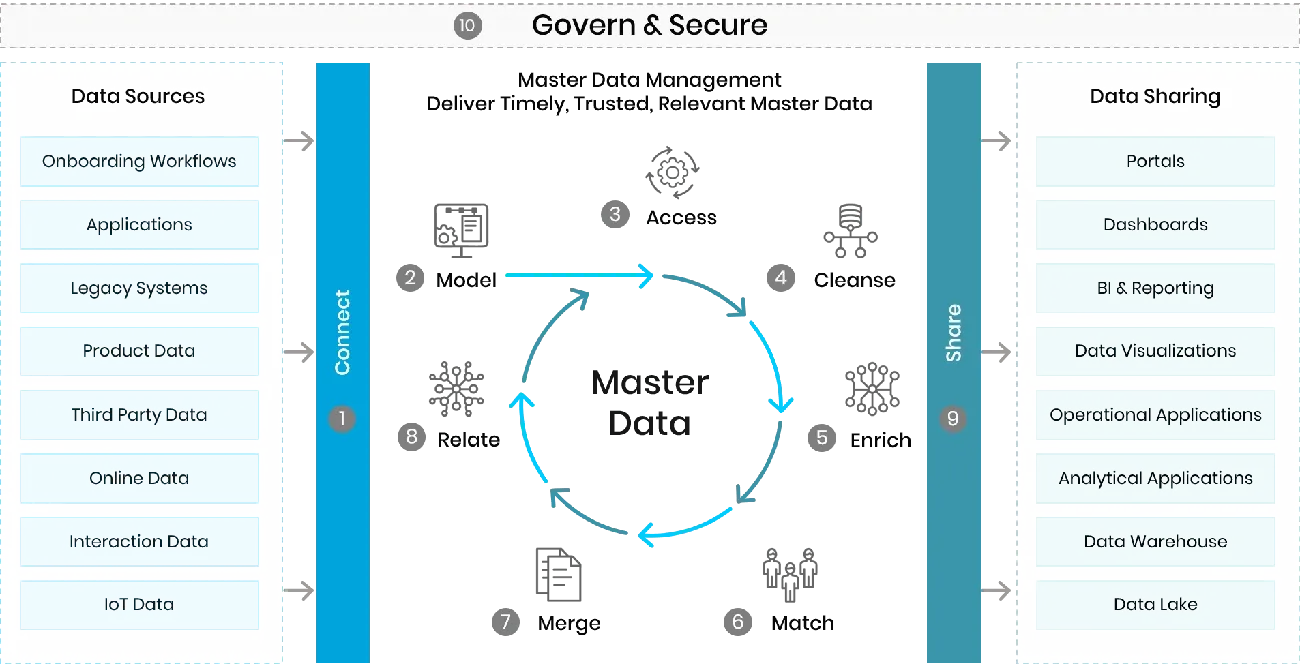
The right mix of workflow automation, Single Source of Truth (SSOT), and Master Data Management (MDM) creates a radical alteration in how organizations manage HR data. Companies that blend integrated HR technology and HR workflow automation into their operations spend 26% less on HR costs. They work with 32% fewer staff members while achieving better results.
A complete HR workflow automation platform with built-in MDM capabilities changes this picture entirely. Organizations that establish a Single Source of Truth for employee data eliminate 80% of reporting problems caused by inconsistent system information. Advanced automation cuts manual data entry costs to 4.86 dollars per entry according to EY. It also reduces security risks from managing multiple disconnected systems by centralizing data in a governed HR Data Warehouse and modern HR data management architecture.
The benefits extend beyond cost savings. Proper data management tackles the human aspect by reducing the burnout rate among HR professionals. It frees them from administrative tasks. Want to make your HR workflows simpler and launch in just one day? Test out Talenode and get a demo today.
Conclusion
The dangers of HR data vulnerabilities go well beyond simple inefficiencies. These issues pose serious threats to organizational wellbeing and employee trust. Work with clients has shown countless HR teams stuck in a cycle of fragmented solutions that make their HR data management problems worse.
Master Data Management and workflow automation provide the detailed solution these organizations need. This approach eliminates conflicting information between platforms. Talenode helps optimize your HR workflows with same-day implementation. See how the solution can revolutionize your HR data management by requesting a demo. Your most valuable asset, your people data, deserves complete protection through proper workflow automation, HR data security, and strong master data governance.
Key Takeaways
Manual HR data workflows create costly vulnerabilities that drain resources and expose organizations to significant financial and compliance risks, but the right automation strategy can transform operations while protecting valuable employee data.
Manual HR processes cost organizations 10-30% of revenue annually through payroll errors (291 dollars per error), I-9 compliance failures (up to 2,191 dollars per form), and administrative inefficiencies that consume 57% of HR teams’ time.
Traditional piecemeal solutions worsen HR data fragmentation by creating disconnected systems that require manual reconciliation, with organizations using an average of 6 different HCM providers that generate security vulnerabilities and reporting inconsistencies.
Integrated HR workflow automation with Master Data Management reduces HR costs by 26% while enabling teams to operate with 32% fewer staff, helping to address the 98% burnout rate by freeing professionals from repetitive administrative tasks.
Establishing a Single Source of Truth (SSOT) for employee data prevents the 80% of workforce reporting problems caused by inconsistent information across systems and creates a foundation for strategic HR initiatives, data workflow automation, and accurate HRIS Data Management.
The path forward requires abandoning fragmented approaches in favor of comprehensive platforms that unify data management, automate HR data workflows, and provide the security and accuracy that modern HR operations demand.
FAQs
Q1. What Are the Financial Consequences of Manual HR Data Workflows?
Manual HR processes can cost organizations 10-30% of their revenue annually. This includes expenses from payroll errors (averaging 291 dollars per error), I-9 compliance failures (up to 2,191 dollars per form), and administrative inefficiencies that consume a significant portion of HR teams’ time. A fragmented HR data workflow also increases hidden costs in HR data compliance and HR data management.
Q2. How Does Workflow Automation Benefit HR Departments?
Integrated HR workflow automation with Master Data Management can reduce HR costs by 26% while enabling teams to operate with 32% fewer staff. It also helps eliminate the high burnout rate among HR professionals by freeing them from repetitive administrative tasks and replacing manual HR data workflows with governed data workflow automation.
Q3. What Challenges Do Organizations Face When Implementing HR Automation?
Common challenges include resistance to change, system integration issues, data security concerns, and the initial cost of investment. However, when organizations select an HR workflow automation platform designed for secure HR data integration automation and HR Data Warehouse alignment, the long-term benefits often outweigh these initial hurdles.
Q4. How Does Establishing a Single Source of Truth (SSOT) Improve HR Operations?
An SSOT for employee data prevents 80% of workforce reporting problems caused by inconsistent information across systems. It creates a foundation for strategic HR initiatives, improves overall data accuracy and reliability, and strengthens HRIS Data Management by aligning every HR data workflow to the same authoritative record.
Q5. Why Do Traditional Piecemeal Solutions Often Fail to Solve HR Data Management Issues?
Piecemeal solutions typically worsen HR data fragmentation by creating disconnected systems that require manual reconciliation. Organizations often end up using multiple HCM providers, which generates HR data security vulnerabilities and reporting inconsistencies, ultimately compounding the problem rather than solving it. A unified approach that combines Master Data Management, a Single Source of Truth, and integrated HR data software is essential to break this cycle.