
Data governance failures hit HR operations where it hurts: payroll errors from incorrect termination dates, broken compensation analysis from missing job levels, mismatched headcount reports when department codes differ between your HRIS and payroll system.
These “small” data problems create real downstream chaos. Employees lose trust when paychecks are wrong. Executives question your analytics when headcount numbers don’t match. Compliance deadlines become emergency scrambles to fix what should have been clean from the start.
Most HR teams know this pain: systems don’t sync, field definitions vary across platforms, and no clear process exists for validating critical worker data. You spend payroll close fixing problems instead of processing payments. Executive meetings become data validation sessions. Compliance reporting turns into last-minute data cleanup projects.
Gartner’s ABCD Framework provides a practical approach to these operational headaches. Four dimensions: Accuracy, Breadth, Consistency, and Depth. Each dimension addresses specific failure points that break payroll processing, analytics reporting, and compliance submissions.
This article explains each ABCD dimension through its direct impact on payroll operations, workforce analytics, and compliance reporting. Real examples from HR operators who fixed these problems, not theoretical frameworks.
Table of Contents
A = Accuracy: Error-Free HR Data
Accuracy means your employee data matches reality. When salary amounts are wrong in your HRIS, payroll runs fail. When termination dates don’t sync between systems, final pay calculations break. When job titles contain typos, analytics reports mislead executives.
HR data accuracy differs from marketing data tolerance. Marketing teams can work with approximations. HR teams cannot: incorrect worker data triggers payroll errors, compliance violations, and employee trust issues.
Common Sources of Inaccuracy in HR Systems
Four primary sources create data accuracy problems in HR operations.
Data silos scatter employee information across disconnected systems. Global companies face this challenge when worker data sits in country-specific platforms that don’t communicate. Updating an employee’s job level in your U.S. HRIS doesn’t automatically update their role in the European payroll system.
Outdated HR technologies lack built-in validation rules. One manufacturing HR director discovered this during payroll close: their legacy system miscalculated overtime for three months without flagging the error. The discovery triggered massive back-pay corrections and damaged employee trust in payroll accuracy.
Manual data entry introduces human error at critical moments. A talent acquisition leader presented hiring metrics to executives until the CFO spotted number inconsistencies. The embarrassing revelation: recruitment data was manually transferred between systems with zero validation checks.
Poor change management processes allow errors to multiply across systems. When a compliance deadline approached for French gender equality reporting, one multinational found inconsistent job classifications across divisions. Result: risk of penalties up to 1% of annual payroll.
Detect these accuracy problems through specific validation checks:
Duplicate record identification
Mandatory field validation
Range checks for numerical values (salary bands, tenure)
Cross-field logic validation (hire date must precede termination date)
Format standardization (phone numbers, addresses)
Approved-value lookups for standardized fields
Date logic verification
Cross-system data reconciliation
Synchronizing Employee Records Across Platforms
Most enterprises run multiple HR systems: your HRIS for core data, payroll system for compensation, BI tool for analytics. Without proper synchronization, these systems drift apart quickly.
Real-time data synchronization prevents accuracy degradation. Tools with write-back capabilities ensure changes in one system propagate correctly to others. When an employee’s department changes in your HRIS, that update should automatically flow to payroll and analytics systems.
Organizations without integrated platforms need regular reconciliation processes:
Identify critical fields that must match across systems
Establish automated comparison routines
Set up alerts when discrepancies appear
Implement standardized data formats
Create clear ownership for resolving mismatches
Mock write-back features allow validation of data changes before they go live. This capability proves valuable during large-scale organizational changes when job level updates affect thousands of employee records.
How Inaccurate Data Affects People Analytics Outcomes
Inaccurate data creates four operational impacts beyond basic frustration:
Wrong strategic decisions: Executives make workforce restructuring decisions based on flawed data, leading to failed initiatives and wasted resources.
Loss of confidence in systems: When HR dashboards display obviously incorrect information, stakeholders abandon analytics tools entirely.
Legal compliance violations: Inaccurate data in regulatory reporting triggers penalties and reputational damage.
Staff inefficiency: HR teams spend 80% of their time cleaning data, leaving only 20% for actual analysis.
Dimension | Definition | HR Example | Impact |
Accuracy | Data is error-free and trustworthy | Employee salary data | Payroll: Incorrect payments |
Fix accuracy problems by treating HR data as a product with defined quality standards. Assign clear field ownership, implement continuous monitoring, and establish data health metrics your team can track daily.
B = Breadth: Capturing the Full Picture of Your Workforce
Breadth measures data completeness across employee profiles. Your HRIS contains accurate salary data, but missing job levels break compensation analysis. Complete location codes in your HRIS, blank fields in payroll: tax allocation errors during quarterly filings.
What Is Breadth in Data Quality?
Breadth tracks whether required fields contain values across worker records. One multinational’s CHRO presented compensation analysis during executive review. CEO asked for breakdown by job families. Problem: 40% of employee records lacked job family assignments. Analysis became incomplete, salary decisions delayed.
Data collection inconsistencies create breadth problems. Healthcare provider tracked 142 data points for clinical staff, 84 for administrative roles. Result: blind spots in workforce planning, broken internal mobility analysis.
Retail organization discovered breadth gaps during payroll tax prep. HRIS had complete location data, payroll system showed blank fields. Tax allocation errors required manual corrections, compliance penalties loomed.
Measure breadth through:
Critical field completeness rates
Cross-system field presence validation
Mandatory attribute coverage by worker type
Time-to-completeness for new hire records
Profile strength scoring by job role
Identifying Missing Data in Employee Profiles
Missing data clusters around specific profile areas. Establish completeness standards for professional qualifications, skills inventories, career preferences, work location details, demographic information for diversity analysis, performance history.
Different HR functions need different completeness levels. Payroll processing requires 100% completion of compensation fields. Succession planning functions with 80% skills data completeness. Each use case needs tailored thresholds.
Aerospace manufacturer created “profile strength score” visible to employees and managers. Gamified data completion while improving analytics capabilities. Regular “data health checks” flag incomplete profiles systematically.
Dimension | Definition | HR Example | Impact |
Breadth | Data completeness across all required fields | Missing job level or cost center | Payroll: Incorrect cost allocation |
Using Predictive Modeling to Fill Data Gaps
Complete data remains the goal, but gaps exist. Technology company discovered 30% of employees lacked skill proficiency ratings needed for workforce planning. Machine learning analyzed job descriptions, performance records, project assignments to predict missing skill ratings.
Approach provided reasonable estimates until actual data collection, allowed strategic planning to continue. Predictive modelling techniques supplement incomplete data: similarity-based modeling, historical pattern analysis, natural language processing, collaborative filtering.
Predictive approaches supplement proper data collection, not replace it. Goal: complete employee profiles through improved processes and user-friendly data capture methods.
C = Consistency: Standardizing Definitions Across Systems
Consistency makes your HRIS, payroll system, and BI tools tell the same story about your workforce. When department codes don’t match between systems, headcount reports become embarrassing contradictions in executive meetings.
Measuring HR Data Consistency
Track consistency through matched values across your HR ecosystem. One company’s quarterly compliance review revealed 32% mismatch between department codes in HRIS versus payroll. Same employees, different department assignments, conflicting budget allocations.
Measure consistency with these metrics:
Format adherence percentage across systems
Field value match rates between platforms
Standardized code adoption rates
Cross-system validation success rates
Change propagation tracking
Healthcare organizations often discover this problem during regulatory reporting: employee count matches between HRIS and payroll, but location codes follow different formats. HRIS shows “US-CA-SFO” while payroll shows “CA-SanFran.” Same location, misaligned workforce distribution reports.
Aligning Job Titles, Departments, and Performance Metrics
Establish golden records as your authoritative data source. Enforce these standards through validation rules and automated reconciliation processes.
Job titles create the biggest consistency headaches. Financial services companies struggle when “Senior Manager,” “Sr. Manager,” and “Manager II” all refer to the same pay grade but appear as separate roles in promotion analysis. Analytics teams can’t track career progression when job titles vary by system.
Performance metrics suffer similarly. Manufacturing companies discover their global ratings use inconsistent scales: 1-5 in North America, A-D in Europe. Comparing performance across regions becomes impossible without data normalization.
Dimension | Definition | HR Example | Impact |
Consistency | Data follows uniform formats and definitions across systems | Department code differs between HRIS and payroll | Payroll: Incorrect cost allocation |
Preventing Format Mismatches in Multi-System Environments
Format standardization prevents the emergency data cleanup sessions before compliance deadlines. Retail companies learn this lesson during payroll tax filings when location codes follow different formats across HR and financial systems, creating tax jurisdiction errors.
Prevent format mismatches through:
Master data governance committees with system representatives
Data dictionaries defining formats and allowable values
Cross-system validation rules flagging inconsistencies
Automated alerts when format violations occur
Clear system ownership for maintaining standards
Technology companies implement “data consistency scores” visible to all HR team members. This gamification approach drives continuous improvement while preventing the scramble to reconcile conflicting reports before executive meetings.
D = Depth: Data Granularity for Workforce Decisions
Depth determines how precisely your HR data captures workforce details. You can have accurate, complete, and consistent data that still fails when executives need targeted analysis or compliance requires specific breakdowns.
How Depth Problems Break Workforce Planning
A retail organization’s HR director presented workforce planning projections during quarterly review. Executive team asked for turnover risk by job family and performance tier. Analysis fell apart immediately.
Their data showed “Sales” as a single job family. No distinction between in-store associates versus online specialists. No performance tier granularity beyond basic ratings. Accurate headcount, complete profiles, consistent formats—but useless for retention strategy.
Depth failures create three operational problems:
Analytics teams can’t slice data for meaningful insights
Targeted interventions become impossible without precise employee segmentation
Compliance reporting requires manual data manipulation when classifications lack specificity
Manufacturing CHRO learned this during engineering talent forecasting. “Engineering” job family masked critical differences: embedded software versus mechanical design versus test engineering. Each required different recruitment strategies, but generic categorization prevented targeted planning.
Dimension | Definition | HR Example | Impact |
Depth | Data granularity at appropriate level for analysis | Job family too generic | Payroll: Minor impact |
Building Proper Data Granularity
Establish tiered granularity requirements based on downstream usage. Payroll processing needs basic job codes. Analytics requires detailed skill taxonomies. Compliance demands specific demographic breakdowns.
Financial services firm collected minimal department data while tracking exhaustive individual metrics. Created a “missing middle” that prevented team performance comparisons. Fixed this by defining minimum classification standards for critical fields: job families, skills, locations, performance dimensions.
Healthcare organization discovered their “training completed” field broke compliance reporting. Expanded to capture training type, date, certification level, expiration status. Eliminated emergency data cleanup before regulatory deadlines.
Progressive profiling works: increase data depth over employee lifecycle rather than demanding complete profiles at hire. Use hierarchical classifications that support both broad views and detailed analysis.
Depth Requirements for DEIB and Performance Analysis
DEIB initiatives fail without granular demographic data. Technology company tracked basic demographics until diversity analysis revealed gaps. Expanded to include caregiver status, military experience, educational background, self-identified dimensions.
Enhanced depth uncovered promotion rate patterns invisible in aggregate reporting. Enabled targeted interventions that improved retention of underrepresented groups.
Performance analysis requires competency-level detail. Manufacturing company struggled with productivity variations across teams. Basic performance ratings provided no insight into skill gaps. Implemented detailed competency assessments, identified specific development needs, created effective training programs.
Team-level depth requirements:
Department structure and reporting relationships
Project assignments and collaboration patterns
Resource allocation and budget responsibility
Individual-level depth requirements:
Skills inventories with proficiency ratings
Performance dimensions beyond overall scores
Career aspirations and development preferences
Historical progression and growth trajectories
Balance analytical power with privacy considerations. Greater granularity requires stronger governance and data protection standards.
Operationalizing ABCD in Daily HR Workflows
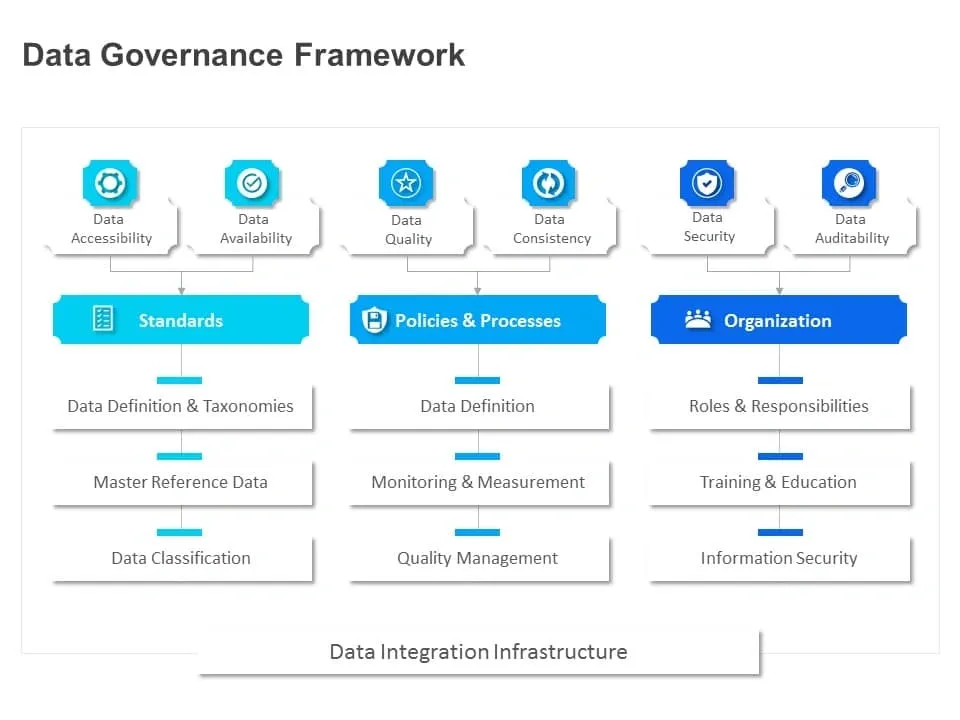
Image Source: SlideUpLift
ABCD frameworks only work when built into daily operations. One financial services team discovered this during payroll close when incorrect termination dates triggered wrong final payments to three departing executives. The fix required manual corrections, delayed payroll, and damaged relationships with departing talent.
Daily Checks for Each ABCD Dimension
Establish routine validation that catches problems before they break operations:
Accuracy checks: range validations for salary fields, cross-field logic tests (hire date before termination date), duplicate record identification, format standardization for phone numbers and addresses.
Breadth monitoring: critical-field completeness rates by worker type, mandatory attribute coverage, profile strength scoring for new hires.
Consistency validation: format adherence across your HRIS and payroll system, field value match rates, standardized code adoption.
Depth verification: granularity levels for job families, skills taxonomies, performance dimensions.
Integration into HRIS and Data Governance Platforms
Treat HR data as a product with defined health metrics. Assign field owners responsible for data quality in specific areas: compensation data owner, organizational data owner, performance data owner.
Set check frequencies based on business impact: daily for payroll-critical fields, weekly for analytics fields, monthly for compliance fields.
Configure cross-system reconciliation alerts between your HRIS and payroll system that flag mismatches before they impact operations.
Ai Data Governance Tools for Automation
Automation prevents the manual scramble. One retail organization avoided compliance deadline panic when AI flagged insufficient data depth for EEO reporting three weeks before submission.
Look for tools with HR-specific validation rules, root-cause analysis capabilities, and ML-powered recommendations for data quality improvements.
Schedule a demo at talenode.ai to turn ABCD into no-code HR data rules, alerts, and a data health score your team can trust.
Conclusion
Gartner’s ABCD Framework fixes the core data problems that break HR operations daily. Accuracy stops payroll errors before they hit employee paychecks. Breadth ensures complete worker profiles for reliable analytics. Consistency eliminates mismatched reports between your HRIS and payroll systems. Depth provides the granular data needed for targeted workforce decisions.
HR teams implementing this framework see immediate operational improvements. Data cleanup time drops dramatically. Executive confidence in HR analytics increases when numbers actually match across systems. Compliance reporting becomes routine instead of emergency weekend projects.
Data quality problems connect: poor accuracy creates consistency issues, missing breadth limits analytical depth. Fix one dimension and others improve automatically. This interconnection makes the ABCD approach particularly effective for resource-constrained HR teams.
The return on data governance investment appears quickly through fewer payroll corrections, faster report generation, and eliminated compliance scrambles. Organizations consistently report 80% fewer payroll errors and 65% faster report preparation after implementing structured data quality processes.
Start with an assessment across all four ABCD dimensions. Focus first on fields that impact payroll accuracy, executive reporting, and compliance deadlines. These critical data points deliver immediate operational value while building foundation for broader workforce analytics.
Poor HR data quality is no longer acceptable. The ABCD Framework provides practical steps to move from broken data processes to reliable workforce information that supports both daily operations and strategic planning.
Key Takeaways
Gartner’s ABCD Framework provides HR teams with a structured approach to transform chaotic data management into strategic advantage through four critical dimensions.
• Accuracy prevents costly payroll errors – Implement daily validation checks and cross-system reconciliation to eliminate incorrect payments and compliance violations that damage employee trust.
• Breadth captures complete workforce picture – Establish profile completeness standards and use predictive modeling to fill gaps, enabling reliable analytics and strategic planning.
• Consistency standardizes definitions across systems – Create golden records and unified formats to eliminate mismatched reports that embarrass executives and delay decisions.
• Depth enables targeted interventions – Collect granular data at team and individual levels to support DEIB initiatives, performance analysis, and precise workforce planning.
• Visualization transforms abstract concepts into action – Use quadrant charts, heatmaps, and real-time dashboards to identify weak spots and monitor continuous improvement.
• Daily operationalization prevents emergency scrambles – Integrate ABCD checks into routine workflows and leverage AI automation to catch issues before they impact business operations.
Organizations implementing this framework typically reduce payroll errors by 80%, cut report preparation time by 65%, and eliminate last-minute compliance panics while building executive confidence in HR analytics.
FAQs
Q1. What Is Gartner’s ABCD Framework for HR Data Governance?
Gartner’s ABCD Framework is a structured approach to HR data governance that focuses on four key dimensions: Accuracy, Breadth, Consistency, and Depth. It helps HR teams improve data quality, enhance analytics capabilities, and make more informed workforce decisions.
Q2. How Can Implementing the ABCD Framework Benefit HR Teams?
Implementing the ABCD Framework can lead to significant benefits for HR teams, including reduced payroll errors, improved data analytics capabilities, more efficient compliance reporting, and increased confidence in HR insights among executives and stakeholders.
Q3. What Are Some Common Challenges in HR Data Governance?
Common challenges in HR data governance include data inaccuracies, incomplete employee profiles, inconsistent definitions across systems, and lack of granularity in workforce data. These issues can lead to errors in payroll, analytics, and compliance reporting.
Q4. How Can HR Teams Visualize Data Quality Using the ABCD Framework?
HR teams can visualize data quality using tools like quadrant charts, heatmaps, and real-time dashboards. These visualizations help identify weak spots in data governance, prioritize improvement efforts, and monitor progress across the four ABCD dimensions.
Q5. What Steps Can HR Teams Take to Operationalize the ABCD Framework?
To operationalize the ABCD Framework, HR teams should establish daily checks for each dimension, integrate ABCD standards into their HRIS or data governance platform, and leverage AI-powered tools for automated monitoring and alerts. This helps prevent data quality issues and supports continuous improvement.