
Many teams drown in spreadsheets despite having HR automation tools at their disposal. Organizations still spend countless hours validating data manually. Picture a typical Monday morning – an analyst bends over their Excel sheet to check hundreds of rows before starting any meaningful work. This tedious process wastes about 12 hours every week in most HR departments, which is exactly where automated data validation in HR can make a measurable difference in HR data accuracy.
Data integrity checks serve a crucial purpose beyond administrative tasks. Manual data entry doesn’t just waste time – it increases HR teams’ operational costs by 20-35%. Manual validation rules take too long and often miss “silent” errors, such as technically valid salaries that don’t align with proper pay bands. Our firsthand experience has shown how the right automated data validation tools and automated data quality processes can revolutionize HR operations.
This piece shows how the right validation processes can help your team save countless hours and minimize compliance risks. Your HR professionals can then focus on their primary role – supporting people rather than monitoring data through spreadsheets, by shifting to automated HR data validation as a standard practice.
Table of Contents
>The High Cost of ‘Stare and Compare’
HR teams often get stuck in the “stare and compare” trap. They waste time checking employee data across multiple systems by hand. This isn’t just annoying – it kills productivity and costs real money.
What 12+ Hours of Manual Checking Looks Like Each Week
The same thing happens every Monday morning. HR analysts sit glued to their spreadsheets. They check employee records before they can do anything meaningful. This reconciliation process includes:
- Making sure new hire details match in payroll and HRIS systems
- Checking if benefit choices line up with eligibility rules
- Double-checking job codes, salary ranges, and department assignments.
A “quick check” turns into lost mornings or full days. Data shows HR teams use up to 25% of their time reconciling data by hand. A team of four analysts loses more than 12 hours each week on these checks instead of working on strategic projects. Adopting real-time data validation and automated data cleaning directly reduces this “stare and compare” burden.
Stop Wasting Mondays on Manual Data Checks. Your team spends hours staring at spreadsheets to find errors when they could focus on developing talent, boosting employee participation, or planning the workforce.
The 20-35% Jump in HR Operating Costs
Bad data checking affects more than just wasted time. Studies prove that data errors can drive up HR costs by 20-35%. Here’s how Direct labor costs pile up when skilled HR professionals spend a quarter of their time checking data. You pay premium rates for basic clerical work.
Missed errors lead to expensive problems down the line. A tech company found that one wrong benefits eligibility date cost them $50,000 in insurance premiums they couldn’t claim back. The mistake showed up only during quarterly audits.
Data mistakes can result in compliance fines. Companies working in multiple states or regulated areas face bigger risks.
Decision-making slows down too. Unreliable HR data means even the best analytics tools can’t give useful insights. Workforce planning drifts away from what’s really needed.
These are classic examples of weak HR system data quality and gaps in HR data governance that could be avoided with automated data integrity checks.
People Just Can’t Handle Big Data Sets Well
Our brains aren’t built to check thousands of data points without making mistakes. Three main problems make manual checking slow and unreliable:
- Cognitive fatigue: People get tired after checking hundreds of records. Row 342 gets less attention than row 1, which leads to inconsistent quality.
- Pattern blindness: People spot obvious mistakes but miss subtle ones across multiple fields. A salary might look fine alone but not make sense with the job grade and location.
- Validation complexity: Modern HR data needs three types of checking:
- Input validation (stopping errors when data is entered)
- Process validation (making sure data moves between systems correctly)
- Logic validation (common sense checks like making sure interns don’t have five direct reports)
Most companies only do the first type, missing logic errors that quietly mess up decisions.
Working harder isn’t the answer – setting up systematic validation rules is. Simple “if/then” rules (if Location=US, then SSN is mandatory) fix 80% of checking problems without complex AI. HR departments can get those 12+ hours back each week and improve their data quality. These rule sets are at the core of data validation best practices and are the foundation for implementing automated validation at scale.
Think about this: saving five hours per analyst weekly and avoiding one compliance fine pays for itself in months. The real question isn’t if you can buy data validation tools – it’s if you can keep going without them, given the clear benefits of automated data validation.
>What Is Automated Data Validation? (Beyond Spell Check)
Automated data validation bridges the gap between error-prone manual processes and truly strategic HR operations. Simple spell checkers just flag obvious mistakes. Complete validation systems transform how organizations maintain data integrity in their entire HR ecosystem.
Definition and Purpose of Automated Validation
Automated data validation systematically ensures information stays accurate, consistent, and compliant—both when entered and throughout its lifecycle. This goes beyond simple error detection and creates a foundation of reliable data that supports confident decision-making and consistent HR data validation standards.
Let’s look at what happens during employee onboarding: A new hire’s information needs manual verification across multiple systems—HRIS, payroll, benefits, and time tracking without automated validation. Each handoff creates a chance for error. A digital gatekeeper applies predefined rules to instantly verify that data meets required standards before it enters your systems.
The validation process works through three distinct layers:
- Input Validation: Prevents errors at the point of entry (mandatory fields, format requirements)
- Process Validation: Ensures complete data transfer between systems (no dropped records during API calls)
- Logic Validation: Performs “sanity checks” based on business rules (an intern shouldn’t have five direct reports)
Reactive Cleanup Vs. Proactive Validation
Many organizations stay stuck in a reactive cycle of data management. They identify and fix errors after these mistakes enter systems and cause damage. This approach resembles mopping the floor while leaving the faucet running.
Proactive validation stops errors from entering your systems. Your team gets automated alerts only when exceptions need human help instead of spending Mondays on Excel audits. These systems apply sophisticated rules:
- Format Checks: Ensuring email addresses follow proper syntax
- Range Validation: Flagging salaries outside predetermined bands for specific job grades
- Cross-Field Validation: Confirming that an employee’s start date doesn’t precede their offer acceptance date
These systems excel at catching “silent” errors—data that looks technically valid but is logically incorrect. A $75,000 salary might pass simple number validation yet still be inappropriate for a senior executive position in your organization.
How Automation Reduces Manual Data Entry Costs
Automated validation’s financial benefits spread throughout HR operations. Teams immediately recover 12+ weekly hours previously spent on manual reconciliation. Analysts can focus this time on strategic initiatives like talent development and workforce planning.
On top of that, automation cuts the downstream costs of error correction. HR teams spend up to 25% of their time on data reconciliation—a major operational expense that disappears with proper validation systems.
The biggest savings come from avoiding costly mistakes. One mid-sized tech firm paid $50,000 in unclaimable insurance premiums due to a single benefits eligibility date error. Organizations of all sizes get great protection against compliance violations and their associated penalties, especially when operating across multiple states or countries.
Implementing effective validation doesn’t need artificial intelligence for every scenario. Simple “if/then” rule engines (if Location=US, then SSN format must be XXX-XX-XXXX) solve about 80% of common validation problems. These straightforward logic checks form the foundation of any effective validation strategy and are often delivered through modern automated data validation tools embedded in HR platforms.
The math becomes clear: saving just five hours weekly per analyst while preventing even one compliance fine delivers payback within months. Organizations must ask themselves if they can afford to continue without these validation tools or modern automated data quality checks.
The 3 Types of Checks Every HR Team Needs
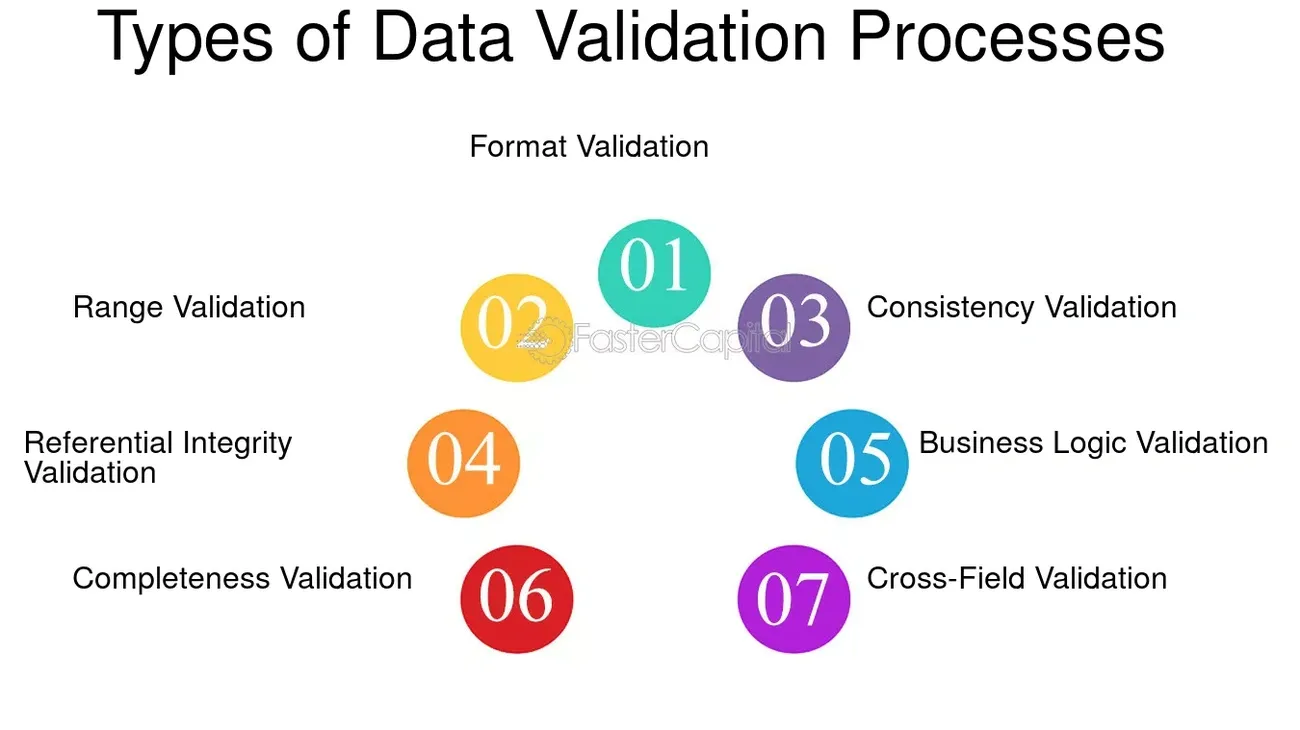
Image Source: FasterCapital
Data validation needs more than a one-size-fits-all solution. HR teams that implement automation tools quickly find they need a complete strategy with three different check types. This strategy helps eliminate those “Monday morning spreadsheet sessions” where analysts look at endless rows of employee data with tired eyes.
1) Format Checks: Email, Phone, Date Formats
Your first line of defense against errors comes from format validation. These checks standardize your data ecosystem by making sure information follows required patterns and structures.
Every HR professional knows the confusion that comes from mismatched date formats. The question “Is 02/03/2023 February 3rd or March 2nd?” creates unnecessary confusion. Format checks solve this problem by using standard patterns (MM/DD/YYYY or DD/MM/YYYY) across your organization.
Format checks also make sure:
- Email addresses have both @ symbol and valid domain extensions
- Phone numbers match country-specific patterns (like XXX-XXX-XXXX for US)
- National IDs follow required formats (SSN, VAT numbers, tax IDs)
- Banking details meet checksum validation for routing numbers or IBANs
These simple checks prevent many downstream errors. Data shows that format validation alone can eliminate up to 35% of common HR data errors that usually waste time during reconciliation.
2) Logic Checks: Chronological and Conditional Rules
Logic checks look at relationships between data points, while format checks look at structure. These validations catch “silent errors”—data that looks right alone but fails when analyzed in context.
A salary validation example shows this clearly: A $75,000 entry looks fine as a number, but logic checks might flag it as too low for a senior executive position in your market. Without this second layer, your team would miss this “technically correct but contextually wrong” error in manual reviews.
Logic checks apply business rules such as:
- Start dates must come after offer acceptance dates
- Salary values should stay within set ranges for specific job grades and locations
- Termination dates can’t come before hire dates
- Benefits eligibility must match employment status requirements
Yes, it is these validations that act as “sanity checks” to prevent logical mistakes. They capture the knowledge of your experienced HR analysts and apply it systematically through automation.
3) Reference Checks: Cross-Field and System Validation
The last validation layer keeps data consistent across your HR ecosystem. Reference checks make sure information in one system or field matches data in another—catching integration errors early.
These checks verify that values like Department Codes or Manager IDs exist in your master tables. If an employee gets assigned to department “MKTG-12” but that department doesn’t exist, reference validation catches this mismatch right away.
International teams need reference validation even more because of country-specific requirements. Systems must handle different national ID types, address formats, and work permit rules.
Common reference checks include:
- Cross-system checks that match benefits eligibility rules with time and attendance data
- Integrity checks to confirm assigned managers exist in your directory
- Department checks to verify cost centers match financial systems
- Job code checks to ensure position codes align with compensation structures
Setting up these three validation types might seem daunting, but modern HR platforms like HR One, Bamboo HR, Gusto, and ADP come with built-in validation tools. The math makes sense: saving five hours weekly per analyst and avoiding one compliance fine pays for itself within months. Together, these checks form a practical data validation best practices framework for HR.
Note that most validation scenarios don’t need artificial intelligence. Simple “if/then” rule engines (if Location=US, then SSN format must follow XXX-XX-XXXX) can solve about 80% of common validation problems.
How to Build Your ‘Validation Rulebook’
A solid validation system needs more than just technology—you just need a well-laid-out approach. Your “validation rulebook” forms the foundation to maintain consistent data quality in your HR ecosystem. Here’s a blueprint that will help you create rules to eliminate those dreaded Monday spreadsheet sessions forever and raise overall HR data accuracy.
Start with the Most Critical Fields
Creating validation rules for every data point at once can overwhelm you and it’s unnecessary. Your implementation will work better if you focus on high-impact fields that directly affect:
- Payroll accuracy: Employee IDs, salary information, banking details
- Compliance obligations: Tax identifiers, work eligibility documentation
- Benefits administration: Eligibility dates, dependent information, plan codes
Start by identifying your most frequent or pricey errors. Most organizations find that 20% of their data fields create 80% of their validation problems. A targeted analysis of these trouble spots can bring rapid improvement with minimal effort.
Field prioritization goes beyond importance—it’s about assessing risks. A wrong value in an employee’s favorite color field won’t matter much, but an incorrect salary multiplier might cost thousands before anyone finds it.
Define Your ‘Golden Rules’ for Data Integrity
After identifying your critical fields, you’ll need clear governance practices to maintain your validation framework:
Data Dictionary: Build a centralized document that defines each HR data field, including its business purpose, acceptable values, format requirements, and system of record. This dictionary becomes your single source of truth for validation parameters.
Clear Ownership (RACI): Each data domain needs specific accountability. A properly implemented RACI chart (Responsible, Accountable, Consulted, Informed) shows exactly who—such as your HRIS Lead, Payroll Manager, or Benefits Specialist—owns specific data sets’ quality.
Access Controls: Role-Based Access Control (RBAC) helps restrict who can create, view, or modify sensitive information. Modern HR platforms like HROne and BambooHR offer granular permissions that minimize unauthorized or accidental changes.
Smaller organizations without formal data governance teams should focus first on fields that affect payroll and compliance. They can expand the framework as capacity allows as part of maturing their HR data governance approach.
5 Common Validation Rules Every Hr Team Should Use
My experience with dozens of implementations shows these five validation rules consistently give the highest return on investment for HR teams:
- Identity Validation: Employee_ID must be unique and never null. Manager_ID must exist in the employee master file and cannot match the employee’s own ID (preventing self-reporting structures).
- Compensation Logic: Base_Salary must fall within established ranges for the employee’s Job_Grade and Location. This catches “silent errors” where a technically valid number might still be inappropriate.
- Time & Attendance Parameters: Daily_Hours must logically range between 0-24. Automated flags should trigger when Weekly_Hours exceeds policy thresholds.
- Cross-System Verification: Benefits eligibility rules (like minimum hours worked) should automatically check against time and attendance data to prevent enrollment errors.
- Banking Validation: Checksum validation for routing numbers or IBANs reduces transfer failures. Payroll errors can seriously damage employee trust.
A regular audit cycle matters as much as creating these rules. You might want to run quarterly data validation audits to check for:
- Duplicate records using combinations of legal name, birth date, and national ID
- Active employees missing critical data (manager, department, job code)
- Status inconsistencies like active employees with future termination dates
- Out-of-range salaries and currency mismatches
Note that your validation rulebook should evolve as your organization grows. Starting with these fundamental rules and expanding gradually helps build a robust system that protects data integrity while freeing your team from manual verification tasks.
The Role of AI in Catching ‘Invisible’ Errors
Strong validation rules still have blind spots. Traditional data checks work with strict parameters. They can confirm a social security number matches XXX-XX-XXXX format but can’t verify if that number makes sense with an employee’s age or location history. This creates an opportunity for artificial intelligence to deliver exceptional value to HR teams.
Traditional Rules Show Their Limits
Standard rule-based validation catches obvious errors but doesn’t deal very well with context-based decisions. Your Monday morning analyst spends hours checking technically correct data that contains logical gaps. Take an employee with a perfectly formatted job code that doesn’t fit their department. Or a salary that meets system rules but seems odd for their role and location.
Rule-based systems also can’t adapt to changing patterns or spot subtle links between multiple data points. Setting up hundreds of validation rules creates its own burden. This gets harder as your organization grows and policies shift.
Using AI for Anomaly Detection in HR Data
Artificial intelligence, particularly machine learning algorithms, takes a fresh approach to validation. These systems don’t just follow preset rules – they study your HR data’s history to understand what looks “normal.”
Machine learning models set baselines and get better at spotting unusual patterns. The system flags anything strange for review, like clusters of similar job titles or unexpected salary changes. These models learn which exceptions make sense in your organization, so false alarms decrease over time.
Live validation stands out as AI’s biggest advantage. Machine learning alerts you right away about issues, unlike those Monday spreadsheet reviews that find errors days after they’ve spread through your systems.
Examples of AI Spotting Outliers in Salary or Job Codes
To name just one example, see how AI catches hidden errors that slip past traditional checks:
A mid-sized tech company’s AI validation system found misclassified contractors. Each record looked fine on paper, but the system spotted odd patterns in work schedules, pay structures, and reporting relationships. This helped prevent what could have turned into expensive compliance issues.
Another organization’s AI flagged unusual salary adjustments. Individual changes stayed within normal ranges, but together they revealed an accidental gender pay gap. Without AI, this might have gone unnoticed until it became a serious problem.
The numbers make sense: saving five hours each week per analyst while stopping just one compliance issue pays for itself in months. That makes these systems practical tools rather than expensive add-ons, especially when combined with robust automated data quality rules.
Implementation: 4 Steps to Stop the Bleeding
Quick action today prevents data errors that waste your HR team’s valuable hours each week. The negative effects of poor data quality are clear, and a systematic solution through these four practical steps will help.
Audit Your Most Frequent Data Errors
Start with a detailed analysis of your current data validation failures. Look for patterns in errors that keep showing up during those frustrating Monday morning Excel sessions. A good way is to track errors for 30 days and group them by type (format, logic, reference) and how often they occur. Data fields linked to payroll, compliance, and benefits administration need extra attention since they lead to the most expensive mistakes.
Write Validation Rules to Catch Them
Now develop specific rules that target your common error types. Each rule needs a clear “if/then” structure. To cite an instance, see “if Location=US, then SSN format must be XXX-XX-XXXX.” Note that basic rule engines can fix about 80% of validation problems without complex AI systems. Your focus should be on three key validation layers:
- Input validation: Stops errors at entry points
- Process validation: Makes sure data transfers completely between systems
- Logic validation: Runs “sanity checks” based on business rules
Automate the Validation Process
In spite of that, rules without automation create more manual work. Your validation rulebook should work through HR automation tools that watch data integrity continuously. Talenode’s automated engine can scan your data 24/7 and catch logic breaks and format errors right away. Contact Ankit@talenode.ai to learn how their system eliminates those Monday spreadsheet reviews while improving data quality significantly. This is a practical path to implementing automated validation across your HR stack.
Route Errors to the Right Data Owner
Even automated systems need human input for exceptions. Clear processes should direct flagged issues to the right data owners based on your RACI chart. Different error types need specific people responsible – your HRIS Lead, Payroll Manager, or Benefits Specialist. Set clear response time expectations and track how well issues get fixed to ensure quick corrections.
The math is simple: when you save just five hours weekly per analyst and avoid one compliance fine, you’ll see returns within months, not years. That alone demonstrates the tangible benefits of automated data validation for HR teams.
Conclusion
Your HR team shouldn’t spend their Monday mornings hunched over spreadsheets. This piece shows how manual data validation eats up more than 12 hours every week. Your HR professionals could use this time for strategic initiatives that add real business value.
Numbers tell the story clearly. Manual validation pushes operational costs up by 20-35%. It also leaves your organization vulnerable to compliance risks and expensive errors. You can’t afford to continue without proper validation tools.
Data validation works through three distinct layers. Input validation blocks errors at entry points. Process validation makes sure data moves completely between systems. Logic validation runs those critical “sanity checks” your team handles manually now. This detailed system catches obvious formatting issues and those sneaky “silent” errors – like technically valid salaries outside proper pay bands.
The solution isn’t as complicated as it seems. Most validation scenarios don’t need sophisticated artificial intelligence. Simple “if/then” rule engines can fix about 80% of common validation problems. Take this example: When Location equals US, then SSN format must follow XXX-XX-XXXX. Computers handle this logic better than tired human eyes.
The return on investment makes perfect sense. You’ll see payback within months by saving five hours weekly per analyst and preventing just one compliance fine. Your HR team will get their Monday mornings back. They can focus on what they do best – supporting your people instead of babysitting data, while your HR system data quality improves continuously.
The next steps are clear. Audit your most common data errors and create specific validation rules to catch them. Set up automation to enforce these rules continuously. Create clear workflows that send exceptions to the right data owners. Your team will soon forget those endless spreadsheet sessions, and you’ll wish you had made this change earlier with automated data validation in HR and automated HR data validation embedded into daily operations.
Key Takeaways
HR teams are hemorrhaging productivity through manual data validation, but implementing automated systems can reclaim those lost hours while dramatically improving data quality and compliance.
- Manual validation costs 12+ hours weekly per team and increases HR operational costs by 20-35%, turning skilled professionals into data entry clerks instead of strategic contributors.
- Three validation layers eliminate most errors: Input validation stops entry mistakes, process validation ensures system transfers, and logic validation catches “silent” errors like inappropriate salaries.
- Simple “if/then” rules solve 80% of problems without complex AI – basic automation can prevent format errors, enforce business logic, and maintain referential integrity across systems.
- Start with critical fields first: Focus validation efforts on payroll-impacting data, compliance requirements, and benefits administration to achieve maximum ROI quickly.
- ROI delivers within months: Saving just 5 hours weekly per analyst while preventing one compliance violation typically pays for validation tools in months, not years.
The transformation from reactive error cleanup to proactive validation represents a fundamental shift that frees HR teams to focus on strategic people initiatives rather than spreadsheet reconciliation, while steadily lifting overall HR data accuracy and HR data validation maturity.
FAQs
Q1. How Much Time Do HR Teams Typically Waste on Manual Data Validation?
HR teams often spend over 12 hours per week on manual data validation tasks, which significantly impacts productivity and increases operational costs by 20-35%.
Q2. What Are the Three Essential Types of Data Validation Checks for HR?
The three crucial types of validation checks for HR are format checks (for emails, phone numbers, dates), logic checks (for chronological and conditional rules), and reference checks (for cross-field and system validation).
Q3. Can Automated Data Validation Replace the Need for Manual Checks Entirely?
While automated validation can significantly reduce manual checks, it may not eliminate them completely. Some complex scenarios or exceptions may still require human intervention, but automation can handle the majority of routine validation tasks.
Q4. What Role Does AI Play in HR Data Validation?
AI enhances data validation by detecting subtle anomalies and patterns that traditional rule-based systems might miss. It can identify “invisible” errors like unusual salary adjustments or misclassified employees, improving overall data integrity.
Q5. How Quickly Can Implementing Automated Data Validation Show a Return on Investment?
Implementing automated data validation can typically show a return on investment within months. By saving just five hours weekly per analyst and preventing even one compliance fine, organizations can quickly recoup the cost of implementation.