

I introduced the ACT Framework earlier as the foundation for clean HR data: Accurate, Complete, and Timely. This article dives deeper into the first pillar of People Data Accuracy by exploring how HR teams can transform their HR data Cleaning processes to ensure error-free, reliable, and trustworthy information. Clean, accurate data is not just a technical necessity but the key to unlocking actionable insights, reliable dashboards, and meaningful AI-driven decisions.
But achieving HR data accuracy is no easy feat. With dynamic employee records, complex systems, and ever-changing organizational structures, the process can be daunting. If not done right, it can lead to wide-ranging HR data issues: teams waste time fixing errors instead of analyzing trends, leadership loses confidence in people insights, and poor data integrity results in delayed or flawed business decisions. Strengthening HR data governance and HR data management practices is vital to prevent these recurring problems.
Common Pitfalls in HR Data Cleaning
While many HR teams understand the importance of clean data, I’ve seen common mistakes derail their efforts. Recognizing and addressing these pitfalls early can save significant time and resources:
- Over-relying on Automation Without Human Validation : Automation is excellent for repetitive tasks but cannot account for context-specific challenges. For instance, reorganizations require human validation to maintain HR data integrity and confirm accurate reporting hierarchies.
- Ignoring Cross-System Inconsistencies : When HRMS, payroll, and performance systems store overlapping data, inconsistencies easily arise. Without centralized oversight, insights remain unreliable. For example, mismatched job titles across systems can cause payroll errors or distort diversity metrics. Maintaining centralized employee data management eliminates these silos and improves HR data quality.
- Cleaning Data Reactively Instead of Proactively : Waiting until a compliance failure or broken dashboard forces action puts HR teams in constant firefighting mode. Adopting proactive processes supported by HR data observability can detect irregularities early and sustain consistent employee data accuracy.
- Focusing Solely on Active Employees : Many HR teams overlook data from contractors, former employees, or temporary staff, which diminishes data quality completeness and creates blind spots in trend analysis. Retaining historical and extended workforce data supports more holistic HR data management.
- Lack of Defined Goals and Metrics : Cleaning efforts often lack measurable outcomes. Teams should track actionable KPIs, such as error reduction percentages, compliance rates, or normalization consistency, to measure their progress in improving HR data accuracy.
Based on my experience, I’ve outlined a scalable, structured approach that supports long-term HR data accuracy and strengthens both integrity and governance.
Five Principles for Scalable and Accurate Data
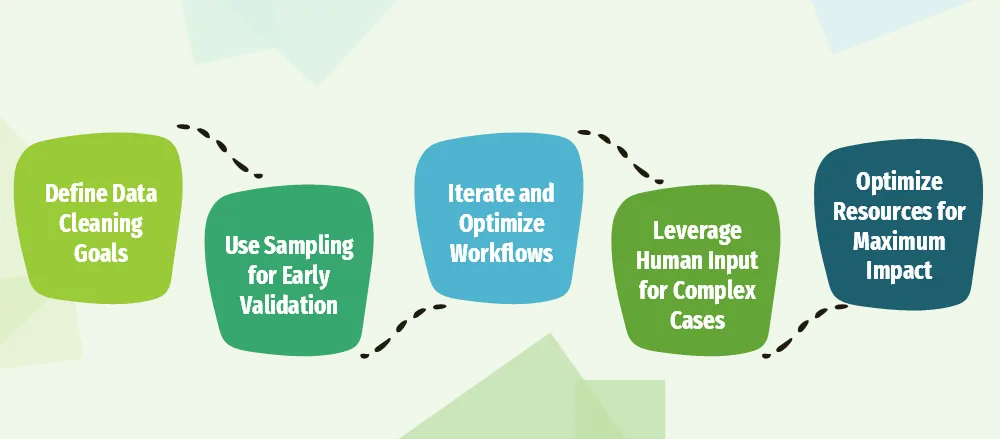
Principles for Accurate Data
1. Define Cleaning Goals with Logical Separation
Before choosing tools or workflows, start with defined goals. Separating the “what” from the “how” allows flexibility in choosing methods and verifying results.
- Remove duplicate employee profiles across geographies.
- Standardize job titles, departments, and employment statuses for consistency.
- Validate demographic and compensation data for compliance accuracy.
This structured clarity is a best practice in HR data governance, ensuring accountability in each phase of the cleaning process.
2. Use Sampling for Early Validation
Sampling small datasets reduces risk while testing strategies for scalability.
- Validate data-cleaning outcomes within one department before applying them globally.
- Pilot error detection rules for demographic fields or mismatched attributes.
- Test correction logic on survey responses to improve normalization accuracy.
Early-stage validation reinforces HR data integrity by minimizing the chance of system-wide rework later.
3. Iterate and Optimize Workflows
HR data cleaning is never a one-time effort—it’s a cycle. Iteration allows refinement as systems, structures, and priorities evolve.
- Payroll teams test error detection rules for mismatches in compensation data.
- Compliance teams audit field-level accuracy in DE&I metrics for persistent reliability.
- Cross-functional reviews ensure processes align with evolving HR data governance requirements.
Iterative improvement drives continuous data quality in HR systems and embeds discipline into HR data management practices.
4. Leverage Human Input for Complex Cases
Automation handles the repetitive, while human insight handles the nuanced.
- Department heads verify reporting hierarchies after reorganization.
- Managers resolve ambiguous or overlapping job functions.
- Employees validate compensation or benefits updates when required.
A balanced approach strengthens both people data accuracy and trust in field-level details across systems.
5. Optimize Resources for Maximum Impact
Not all data-cleaning tasks deliver equal value. Allocating resources wisely improves efficiency and return on effort.
- Automate low-risk tasks such as standardizing employee IDs or correcting case formats.
- Focus human validation where accuracy is mission-critical—compensation, workforce planning, or compliance fields.
- Prioritize workloads with measurable business value, ensuring ongoing HR data accuracy and resilience.
Conclusion: Laying the Groundwork for ACT Data
Accurate people data is the foundation for confident decision-making. By addressing HR data issues, implementing iterative cleaning methods, and reinforcing HR data governance, organizations can build high-integrity datasets that transform HR into a strategic, data-driven function.
Achieving employee data accuracy and data quality in HR systems not only builds trust across teams but also paves the way for advanced automation and AI-driven workforce analytics. Clean, governed datasets enable strong cross-platform integration and truly centralized employee data management, unlocking business value at scale.
With accuracy as the first step in the ACT Framework, the next article in this series will explore how to achieve data completeness—the second pillar that ensures every HR decision is based on data that’s both accurate and comprehensive.
Stay tuned.