

In my work with HR teams across industries, I’ve observed how incomplete data often undermines their ability to make impactful decisions. Whether it’s reconciling fragmented systems, capturing data for non-traditional workforces, or preserving historical records, ensuring HR data completeness can feel like solving a massive puzzle.
Data completeness isn’t just about filling in blanks—it’s about building a foundation where every piece of workforce information contributes to accurate, holistic, and reliable insights. In this article, I explore the second pillar of the ACT Framework—Completeness—and share practical strategies, drawn from client experiences, to achieve complete people data. If you missed the first article in this series on Accurate People Data, you can read it here.
Why Data Completeness Matters
Complete data is critical for HR decision-making because every missing piece creates gaps that weaken insights, governance, and credibility. High HR data quality depends equally on ensuring accuracy and data completeness. Missing or incomplete records create several challenges:
- Skewed Metrics: Incomplete workforce data leads to inaccurate diversity or compensation reports, affecting leadership’s ability to make informed calls.
- Missed Trends: Historical data gaps make it difficult to identify key trends, such as role-specific attrition risks, limiting workforce planning efforts.
- Eroded Credibility: Dashboards built on partial records erode stakeholder trust. One client’s leadership confidence dropped when incomplete data led to poor workforce projections.
- Inefficiency: HR teams spend excessive time reconciling missing data instead of producing insights. Without a complete view, automation and analytics suffer, drastically reducing HRIS data quality.
- Compliance Risks: Missing demographic or employment data can trigger non-compliance with DE&I or statutory reporting requirements, creating financial and reputational damage.
Without employee data completeness, even accurate records lose their value. Completeness provides the contextual layer that drives effective reporting, compliance, and strategic decision-making.
Key Challenges in Achieving Completeness
Ensuring HR data completeness comes with its own complexities. Based on my collaborations with different organisations, below are the common barriers:
- Overlooking Non-Traditional Workers
Contractors, freelancers, gig workers, and interns often sit outside traditional HRMS or ATS environments. Excluding this segment compromises data completeness metrics, distorts labour costs, and weakens diversity analysis. For instance, one client discovered their workforce cost estimates were inaccurate because contractor hours weren’t captured in payroll data—an eye-opening data completeness example. - Fragmented Systems
When data is dispersed across platforms—HRMS, ATS, Payroll, or L&D—it creates gaps and misalignment. At one fast-scaling startup, skills tracked in the ATS didn’t migrate to the HRMS post-hiring. This fragmented structure lowered HR data quality and delayed development planning. - Historical Data Loss
Many organisations delete or archive data from former employees, losing context-critical insights. One client’s inability to review attrition data over time made it impossible to forecast retention challenges—a vital case for improving data completeness through historical retention. - Evolving Organisational Structures
Mergers, reorganisations, and rapid scaling can spawn inconsistent or duplicated records. Outdated taxonomies, mismatched codes, or structural gaps lead to incomplete databases that fail data completeness testing. After one merger, team codes across subsidiaries did not sync, creating duplications across departments and skewing HR reporting.
Steps to Achieve Data Completeness
I have supported organisations in building people-data strategies anchored in HR data completeness, and these practical approaches have proven effective:
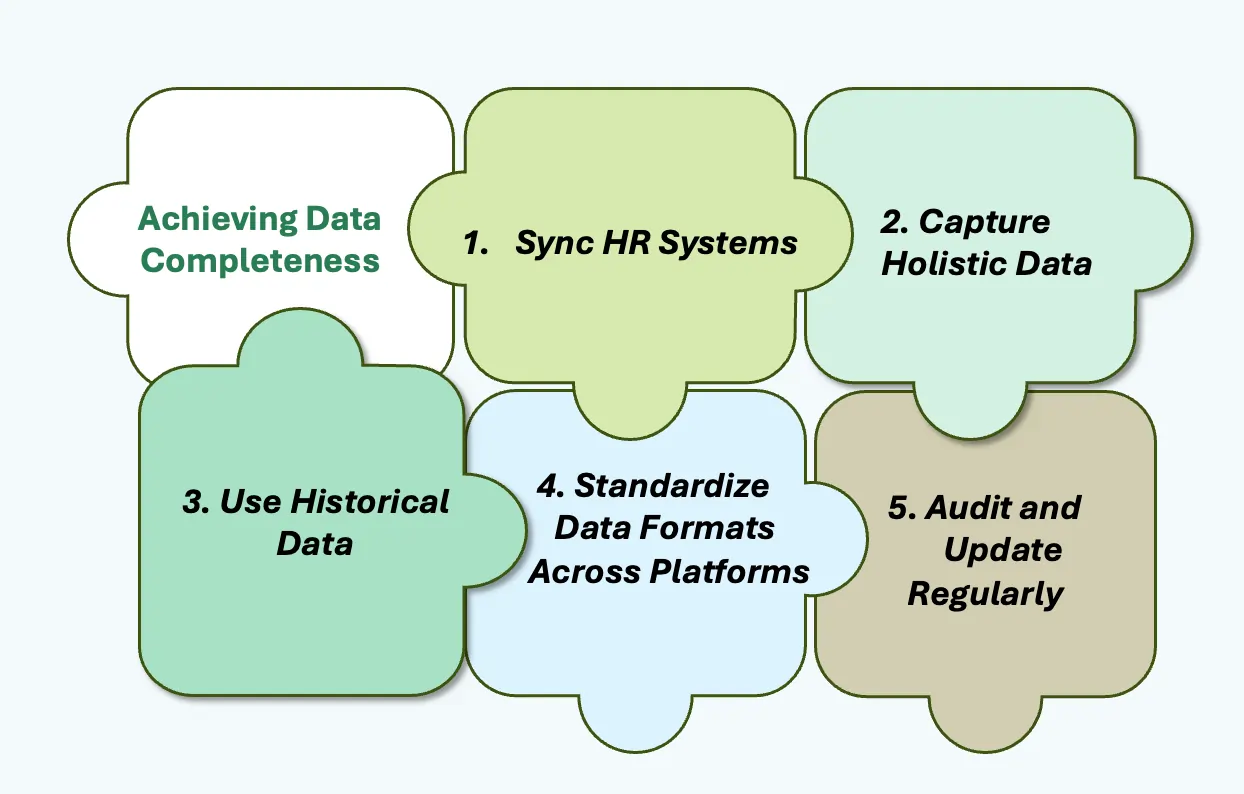
Steps to Achieve Complete People DataSteps to Achieve Complete People Data
- Integrate and Sync Systems
Connect ATS, HRMS, and payroll through APIs or integration middleware to ensure seamless information flow. System connectivity enhances HRIS data quality and prevents missing data fields by aligning attributes at every stage of the employee lifecycle. - Capture Data for Non-Traditional Workers
Incorporate gig workers and contractors in central systems for a holistic workforce view. One organisation achieved better workforce modelling after tracking contingent workers’ hours and including them in reporting dashboards. This step directly supports improving data completeness. - Preserve and Use Historical Data
Archiving employee records rather than deleting them provides continuity. Clients that retained data from exited employees—such as performance and compensation—have used it to identify retention trends and workforce evolution. - Standardise Data Formats Across Platforms
Develop structured naming conventions for titles, departments, and grades across systems to avoid record fragmentation. Aligned formats form the backbone of dependable data completeness metrics, ensuring dashboards display integrated and accurate insights. - Audit and Update Regularly
Conduct periodic data completeness testing to identify and fill information gaps. Review demographic, job, and compensation data quarterly to enhance HR data quality and maintain strong audit readiness.
Completing the ACT
Achieving HR data completeness enables HR teams to make holistic, contextual, and trustworthy decisions. By integrating data flows, capturing the full workforce, and maintaining historical visibility, organisations can significantly elevate data quality completeness and strengthen evidence-based decision-making.
Together with Accuracy and Timeliness, HR data completeness forms the cornerstone of the ACT Framework—empowering HR to make real-time, reliable, and strategic decisions built on data that is accurate, complete, and current.
Where have you encountered challenges with incomplete workforce data? What practices have helped your team ensure better completeness and higher HR data quality?