
In my previous article, I explored the idea that AI, like raising a child, requires thoughtful guidance, patience, and consistent support to realise its full potential. This nurturing analogy highlights a key truth: AI for HR starts in its cradle with basic capabilities but needs structured care to grow into a capable partner for human decision-makers. Transforming AI into a strategic thought partner requires us, as HR practitioners, to go beyond its generic training and build a strong, HR-specific foundation.
When we hear that a model is trained on billions of parameters, it sounds impressive. However, this training is often based on vast, generic data, giving AI in HR surface-level knowledge across topics. While this enables it to perform simple analytical tasks—like summarizing engagement surveys or tracking headcount trends—it often lacks the depth required for complex domains such as AI in performance management or AI in recruitment, where decisions directly affect people outcomes.
Furthermore, much of this generic data contains synthetic or random information, artificially generated to expand datasets but often lacking real-world context. For instance, synthetic datasets may simulate employee feedback patterns or hiring trends but fail to reflect the nuance and dynamic nature of actual organizational behavior. These distortions can lead to inaccuracies and AI bias in HR, limiting the model’s ability to deliver trustworthy, actionable insights grounded in specific business ecosystems.
To truly elevate AI for HR, we must train it on high-quality, people-centric data, strengthen HR data readiness, and embed reasoning techniques like Chain-of-Thought (CoT) logic. Through these steps, HR teams can build AI models capable of reflective learning and robust interpretation, turning automation into strategic insight.
This journey extends far beyond standard implementation. It is a transformation powered by clean data, contextual fine-tuning, ethical review, and human oversight—the hallmarks of modern HR AI solutions that drive a more data-driven HR strategy.
Table of Contents
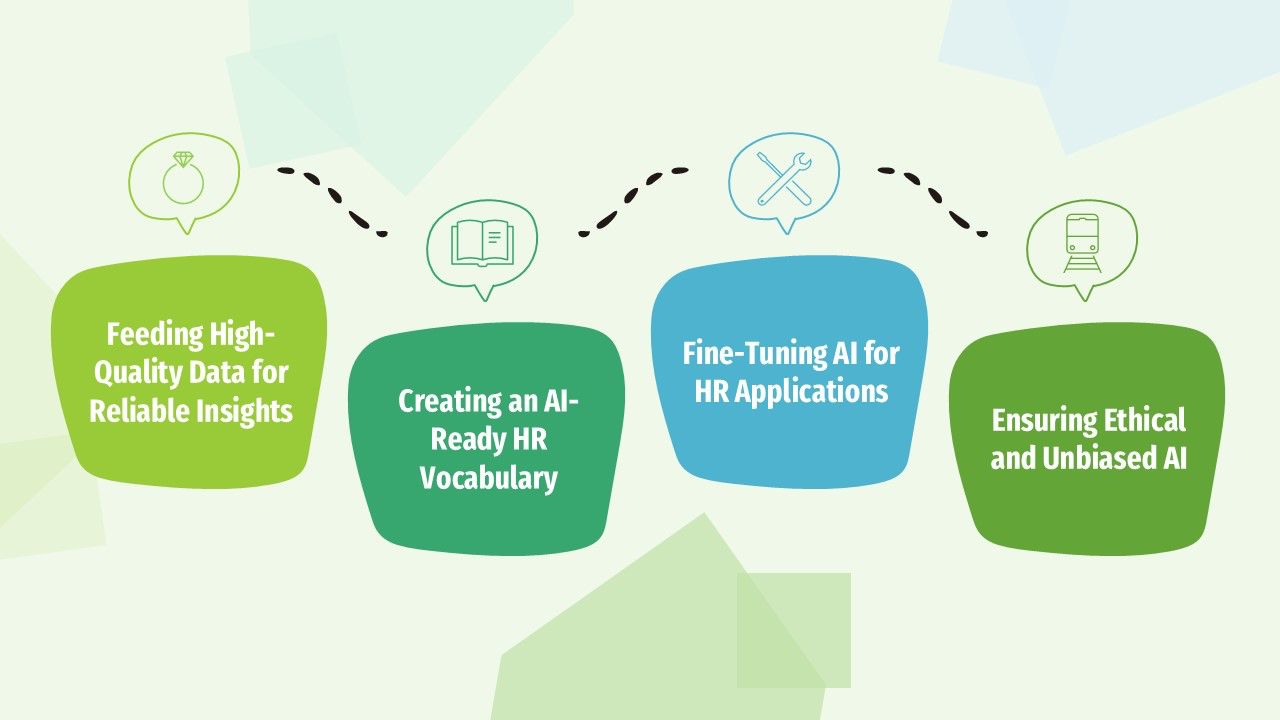
Key Milestones in AI Prep Journey
Here’s a closer look at how we can set up AI for long-term success in HR.
i) Feeding High-Quality Data to get Reliable Insights
High-quality data forms the foundation of every successful HR technology transformation. The principle is simple: AI performance depends on input integrity. Accurate, consistent, complete, and timely data ensures meaningful outputs across HR data management systems.
Start by filtering out irrelevant or inconsistent records. Eliminate duplicates, fix outdated employee hierarchies, and standardize field-level data definitions. When HR data quality is compromised—say, by mismatched job codes or outdated business unit names—the predictive capability of machine learning HR models weakens drastically. AI cannot discern what to ignore without contextual cues, making proactive data hygiene and structured metadata indispensable steps in improving HR data accuracy before scaling automation.
ii) Building a Vocabulary for AI to Understand HR Language
Developing an internal HR lexicon gives structure to your data and clarity to your model. Defining terms with precision enables AI for talent management to interpret organization-specific contexts correctly. For example, “engagement score” may loosely mean employee satisfaction across industries, but internally, it might reflect specific composite metrics involving tenure, career growth, or leadership perception.
By crafting a glossary of contextualized definitions—covering topics such as DE&I, payroll adjustments, or performance metrics—and maintaining strong documentation hygiene, HR teams ensure consistency in HR data governance. This step enhances HR data integrity and creates a shared data language, helping AI recognize organizational semantics accurately even as structures evolve.
A clean, standardized vocabulary also supports smoother integration during larger-scale HR technology trends, helping future models evolve with company needs rather than being limited by legacy configurations.
iii) Fine-Tuning AI for HR Applications
Fine-tuning strengthens domain relevance by training the AI using your organization’s own data assets—performance reviews, engagement results, or talent pipeline records. This approach transforms generic algorithms into specialized frameworks aligned with real-world business goals.
For instance, in AI in recruitment, the model learns organization-specific hiring criteria, while in AI in performance management, it understands the difference between productivity metrics and leadership evaluations. When combined with predictive analytics in HR, fine-tuned systems can identify potential attrition hotspots, model workforce scalability, and recommend actionable interventions.
Fine-tuning also supports contextual HR automation, enabling people analytics dashboards to deliver rapid, data-driven recommendations grounded in high HR data quality.
iv) Monitoring for Bias and Ethical Considerations
Ensuring fairness is non-negotiable. AI systems reflect the biases present in their training data, making AI bias in HR one of the most critical challenges for practitioners to manage. Recruitment algorithms that unconsciously favor certain demographics or performance evaluators skewed by historical inequities reflect flaws in both design and governance.
To mitigate this, HR leaders should combine human validation with systematic bias checks embedded in pipelines. Monitoring dashboards designed through HR data observability techniques can trace error origins and flag inconsistent model behavior across use cases. This continuous oversight process improves transparency, strengthens HR data governance, and ensures both accuracy and accountability in AI-driven decisions.
By deliberately curating diverse, representative datasets and continuously monitoring system outcomes, HR professionals can reduce risk while enhancing HR technology transformation maturity.
The Human Role in AI’s Growth
Just as we mentor emerging talent, we must nurture AI to evolve into a reliable decision partner. True progress lies not just in code or computation but in collaboration—where human judgment reinforces machine logic.
AI for HR is not a replacement for human insight; it’s an amplifier. When designed around ethical frameworks, robust data stewardship, and contextual fine-tuning, it becomes a powerful extension of HR’s influence.
The end goal is clear: empower HR to make informed, ethical, and scalable decisions powered by data-driven HR strategy and safeguarded by enduring HR data management and HR data integrity.
The AI revolution in HR isn’t just about algorithms and automation—it’s about aligning technology, governance, and human empathy to build the next generation of intelligent, inclusive workplaces.
What steps have you taken to prepare AI models for your HR teams? Which challenges persist on your journey toward responsible AI for HR?